
What Is Wireless DMX? The Complete Guide
The Ultimate Guide
Table of Contents
- Two Paths to Wireless DMX
- The Technological Transformation Driven by Wireless DMX
- Cost Savings by Eliminating Expensive 120-Ohm Specialty Cable
- Maximum Efficiency for Gaffers and Best Boys on Set
- Self-Sufficient Architectural Lighting Without a Permanent Operator
- Lighting Control via Tablet with AIR2DMX Simple DESK Mobile
- Professional Laptop Control with AIR2DMX Simple DESK
- Software Compatibility and MIDI Mapping via Third-Party Tools
- Smart Hotspot Mode for Self-Contained Wireless Networks
- Hotspot Cascading: One Transmitter for Three Receivers
- Integration into Existing Wi-Fi and Audio Networks
- Simple Setup via App and Web Interface
- Compact Neutrik-Format Design for a Clean Look
- Fail-Safe Features: Hold Last Value and Static Scenes
- Process Reliability and Time Savings in Trade Show Builds
- Sustainability Through Firmware Updates
- Efficient Data Distribution via Art-Net Broadcast
- Targeted Signal Control via Unicast Communication
- Signal Integrity Through Line-of-Sight Awareness
- Improved Safety by Eliminating Trip Hazards
- Quality and Expert Support, Made in Germany
- Frequently Asked Questions About Wireless DMX
Two Paths to Wireless DMX
Many people searching for “wireless DMX” don’t realize the term covers two fundamentally different technologies.
Classic radio DMX works as a pure point-to-point link: a transmitter takes the DMX signal over cable and sends it via a proprietary radio protocol in the 2.4 GHz band to a receiver, which outputs it again as standard DMX512. There’s no network, no IP addresses — just a transmitter and a receiver. These systems are common in rental and touring, usually as a fixed transmitter/receiver pair.
Wi-Fi DMX over Art-Net — the technology behind AIR2DMX — takes a different approach: the DMX signal is packaged into network packets and sent over ordinary Wi-Fi, the same way a Wi-Fi router carries internet traffic. The AIR2DMX interface receives these packets and converts them back into a standard DMX512 signal for the connected fixtures. Besides Art-Net, sACN (ESTA standard E1.31) is another open network protocol used for Wi-Fi DMX in the industry — AIR2DMX interfaces currently work exclusively with Art-Net; sACN is not supported at this time.
The difference is more than technical fine print: Wi-Fi-based systems can be integrated into an existing network, run multiple universes at once, and be controlled from any Wi-Fi-capable device — laptop, tablet, or smartphone — without extra transmitter hardware. If you’re searching for “radio DMX” with a classic point-to-point link in mind, AIR2DMX still gives you a working answer: no cable, full control — just over Wi-Fi instead of a proprietary radio protocol.
The Technological Transformation Driven by Wireless DMX
The era when long DMX cables and tedious troubleshooting in complex XLR runs dominated daily work is finally over, thanks to modern wireless solutions. With the arrival of Wireless DMX, the events industry has undergone a fundamental transformation, letting technicians realize even the most demanding setups in a fraction of the time it used to take. By transmitting digital control signals over radio with high efficiency, AIR2DMX® technology eliminates physical barriers like walls or long distances — and creates entirely new flexibility in stage design. This innovation combines the highest industry standards with the reliability that professionals require for TV productions, concerts, or exclusive gala events.
Cost Savings by Eliminating Expensive 120-Ohm Specialty Cable
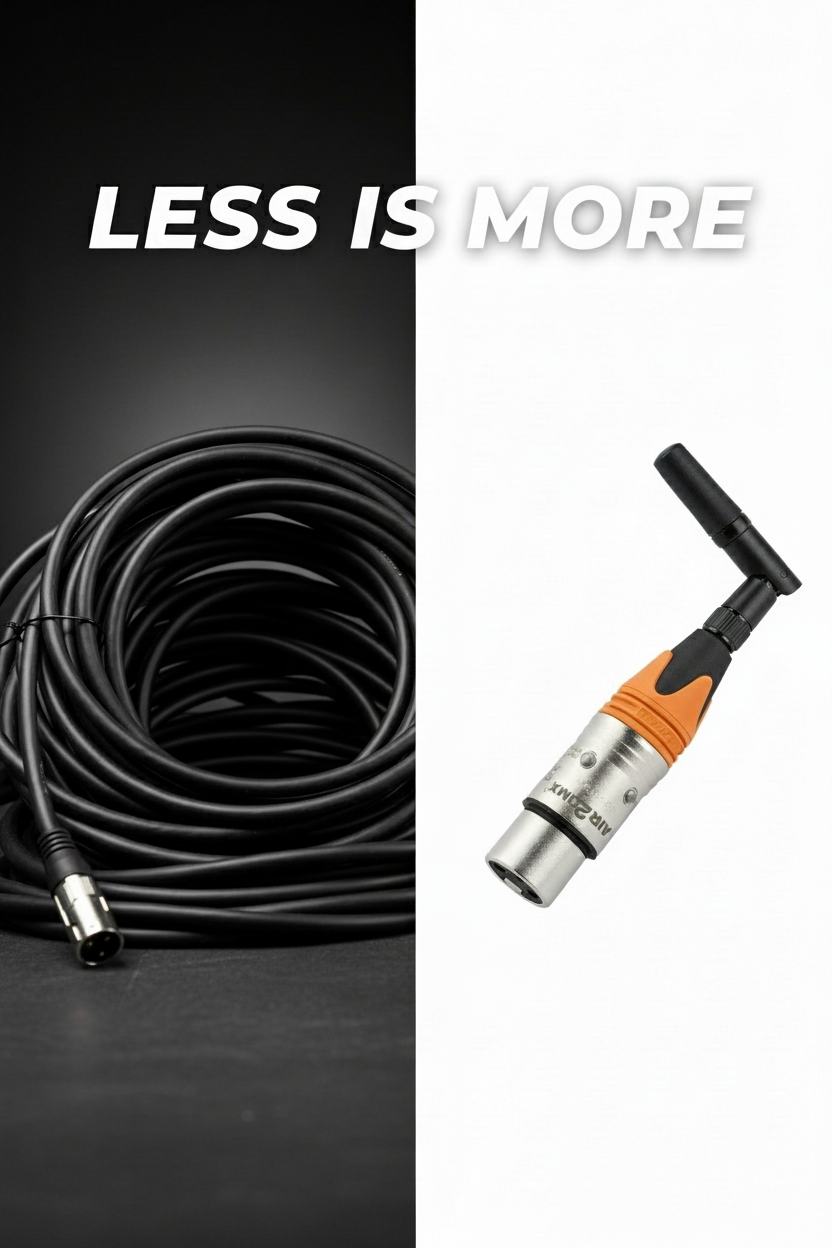
An often underestimated cost factor in professional lighting is the special DMX cable, which — due to its required 120-ohm impedance — is considerably more expensive than standard microphone cable. Using regular XLR cable without the correct impedance risks signal reflections and uncontrollable flickering of fixtures — a risk that professionals rule out from the start with Wireless DMX. AIR2DMX® pays for itself quickly: it removes not only the high cost and mechanical wear of specialty cable, but also drastically cuts the paid labor time needed to run it. Wireless transmission therefore delivers not just technical freedom but a tangible economic advantage over classic cabling.
Maximum Efficiency for Gaffers and Best Boys on Set
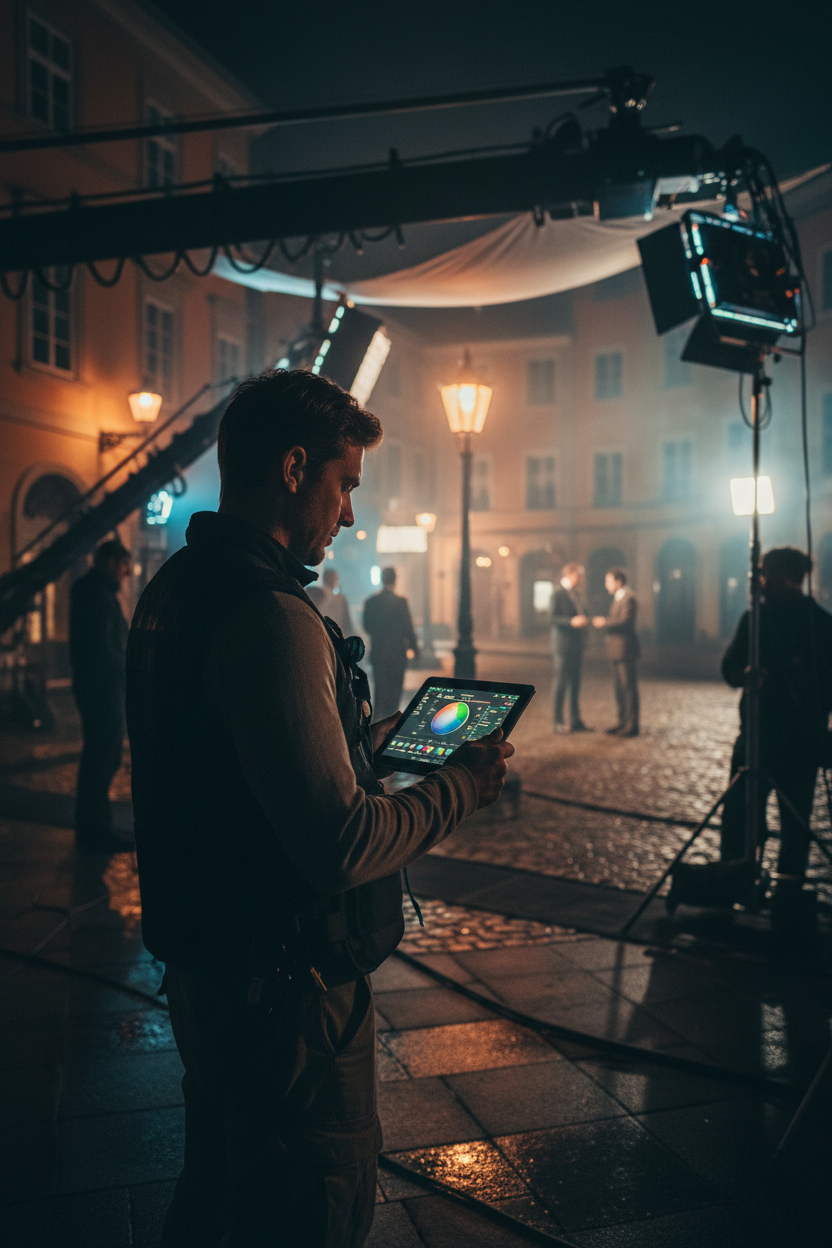
In the hard reality of professional film and video production, time is often the most expensive resource — which is why Wireless DMX has become an indispensable standard tool for gaffers and best boys. While classic setups had to wire every light source by hand, AIR2DMX®’s wireless solution gets every fixture ready to go instantly, without tripping hazards in the sensitive camera frame. Today, the entire set lighting can be adjusted dynamically from a distance, so lighting designers can correct color temperature and intensity in real time — without interrupting the shoot to make manual adjustments at the fixture. This massively streamlines the whole crew’s workflow and allows creative lighting changes between takes in seconds.
Self-Sufficient Architectural Lighting Without a Permanent Operator
Lighting up historic façades or modern buildings artfully often means planners face a challenge: no permanent operator can be on site to start the system. This is where Wireless DMX shows its strength, with features like “DMX at Startup,” where the AIR2DMX® interface outputs a preset static scene the instant power is switched on. This is ideal for architectural projects where the whole installation needs to display the correct lighting look as soon as the power comes on each morning, without a control computer running. Wireless freedom also guarantees a permanently stable connection that holds up even under difficult structural conditions, ensuring low-maintenance control for years.
Lighting Control via Tablet with AIR2DMX Simple DESK Mobile
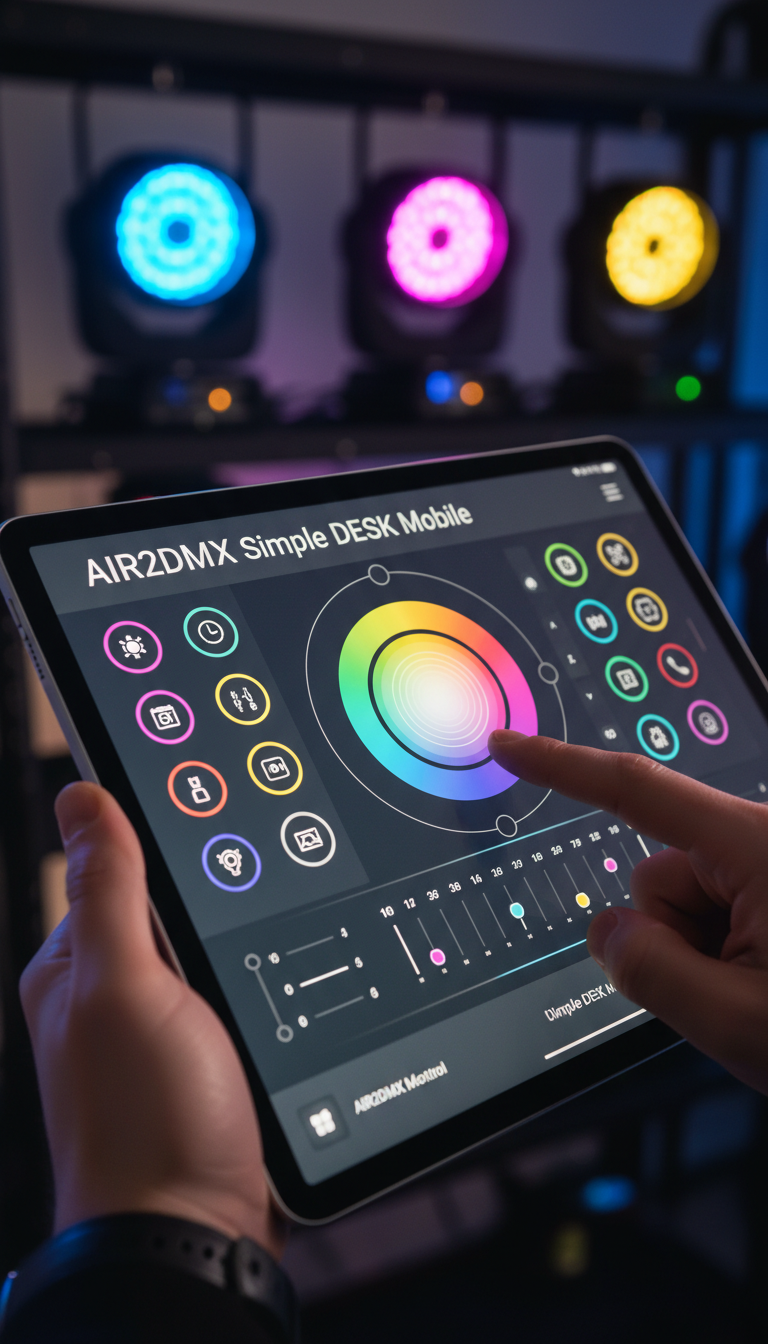
Modern lighting control has moved from bulky consoles to compact mobile devices that, thanks to Wireless DMX, give you full control from anywhere in the venue. Our in-house software, AIR2DMX Simple DESK Mobile, lets you integrate tablets, iPads, and smartphones seamlessly into the system, so you can direct colors, movement, and effects intuitively via touchscreen. This mobile independence lets the operator judge the lighting look directly from the audience’s perspective and make instant fine adjustments, without being tied to a fixed control position. The wireless connection provides a freedom of movement never seen before — a major advantage, especially for spontaneous events or sprawling venues.
Professional Laptop Control with AIR2DMX Simple DESK
For demanding shows, the laptop paired with Wireless DMX remains the undisputed powerhouse of lighting control, with the interface acting as a universal bridge. Our in-house software, AIR2DMX Simple DESK for laptops, is optimized for maximum stability and intuitive operation, delivering perfect results even under time pressure. AIR2DMX®’s specialized hardware converts the laptop’s digital commands into physical DMX signals without latency, ensuring top-tier technical performance. This combination of powerful native software and an extremely reliable wireless link forms the backbone of any modern production that demands the highest visual precision.
Software Compatibility and MIDI Mapping via Third-Party Tools
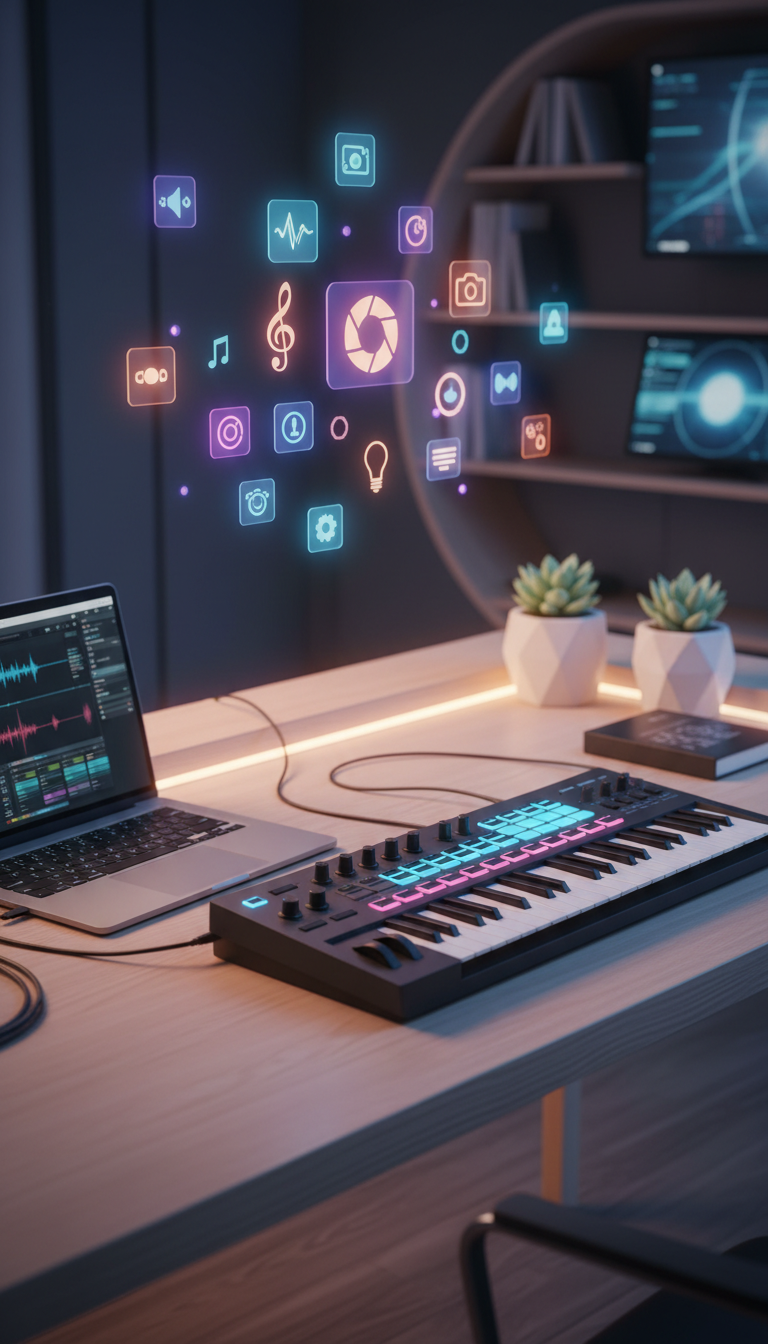
Although our in-house AIR2DMX Simple DESK software is built for maximum simplicity and doesn’t support MIDI itself, the AIR2DMX® interface gives you the freedom to use professional third-party software for complex MIDI mapping. Programs like FreeStyler, DMXControl, StageLight App, or well-known Steinberg software connect without trouble, letting you trigger lighting commands via MIDI keyboards, foot pedals, or DAW automation. The interface acts as a reliable Art-Net receiver here, passing the external software’s commands precisely on to the fixtures. This lets musicians and lighting technicians keep using the software environments they already know, while still benefiting from the AIR2DMX® system’s wireless freedom.
Smart Hotspot Mode for Self-Contained Wireless Networks
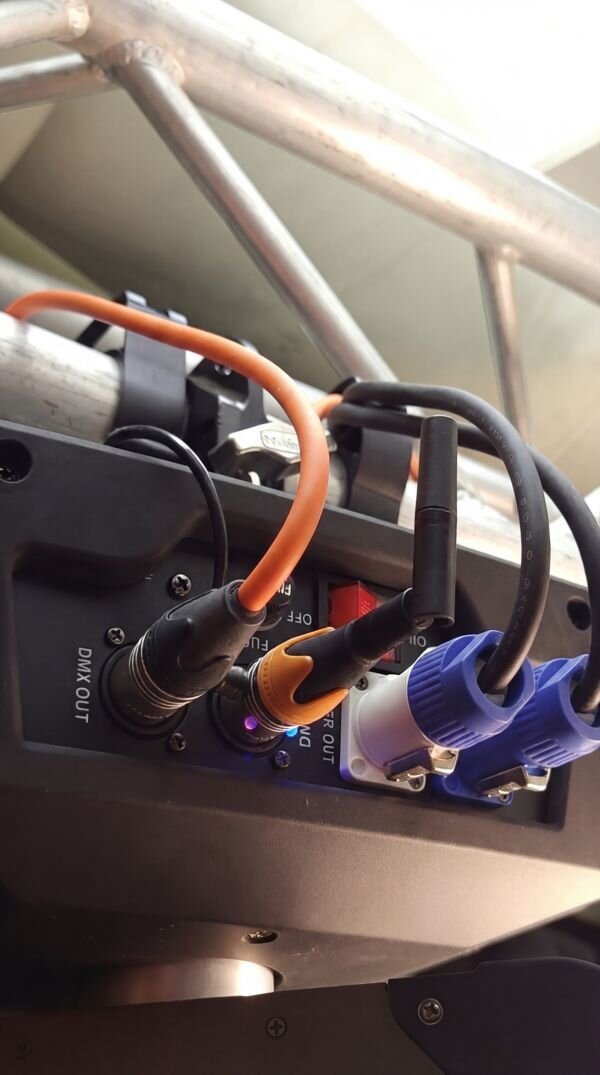
A technical highlight for mobile use is the built-in hotspot mode, which lets the control device and the AIR2DMX® interface communicate directly without needing an external router. The device running the software acts as the active transmitter, while the interface acts as the receiver. As soon as the device is powered on, it sets up its own protected wireless network that the laptop or tablet can simply join. The interface acts as the anchor point for the wireless link, making a separate network infrastructure unnecessary for smaller setups. This self-contained solution is ideal for quick jobs, mobile DJs, or spontaneous presentations, where every minute of setup time counts.
Hotspot Cascading: One Transmitter for Three Receivers
For mid-sized setups, the AIR2DMX® system offers an impressive hotspot cascading feature that reduces the hardware required even further. In this configuration, a single interface configured as a hotspot can reliably feed control data to up to three other AIR2DMX® devices set as receivers. This “one for all” principle makes an extra router at FOH (Front of House) completely unnecessary and keeps the technical setup extremely compact and tidy. This direct point-to-multipoint connection guarantees high signal stability and significantly simplifies logistics for tours or changing event venues, without relying on external network hardware.
Integration into Existing Wi-Fi and Audio Networks
A key advantage of AIR2DMX®’s modern network technology is the ability to run Wireless DMX over an existing Wi-Fi system and router. Because the system is based on the universal Art-Net protocol, lighting control data can be transmitted alongside other services — like audio remote control — on the same hardware infrastructure. That means you don’t need to build competing wireless cells, which significantly increases the overall operational reliability of the event and simplifies frequency management. This shared-infrastructure approach reduces on-site equipment and allows cross-discipline use of stable network environments built on existing professional routers.
Simple Setup via App and Web Interface
Setting up an AIR2DMX® system is deliberately designed to be user-friendly, removing technical hurdles on site entirely. Thanks to the AIR2DMX Simple DESK app, technicians don’t have to hunt for assigned IP addresses in the router, since the software automatically identifies every interface on the network. Alternatively, any device in hotspot mode can be accessed and configured directly via its IP address, 2.0.0.1 (over HTTP, not HTTPS), in a browser, giving quick access to every parameter. This intuitive setup approach ensures the wireless link can be put into safe operation in minutes, regardless of the user’s IT experience.
Compact Neutrik-Format Design for a Clean Look
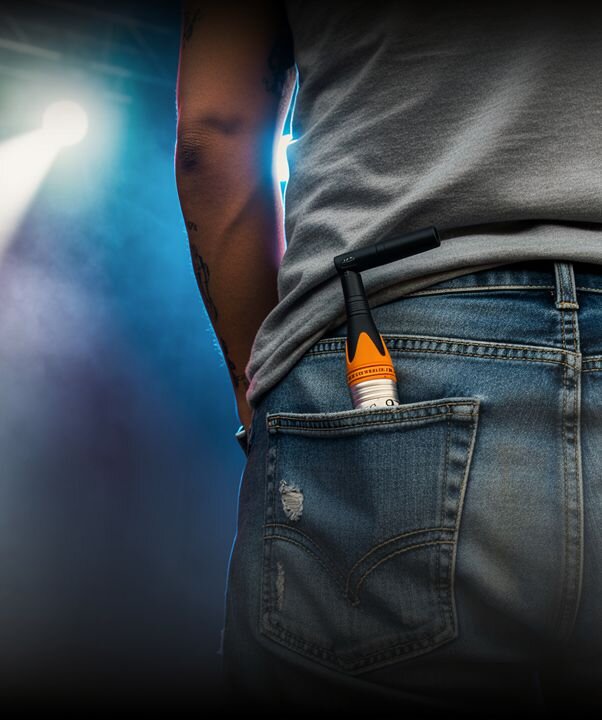
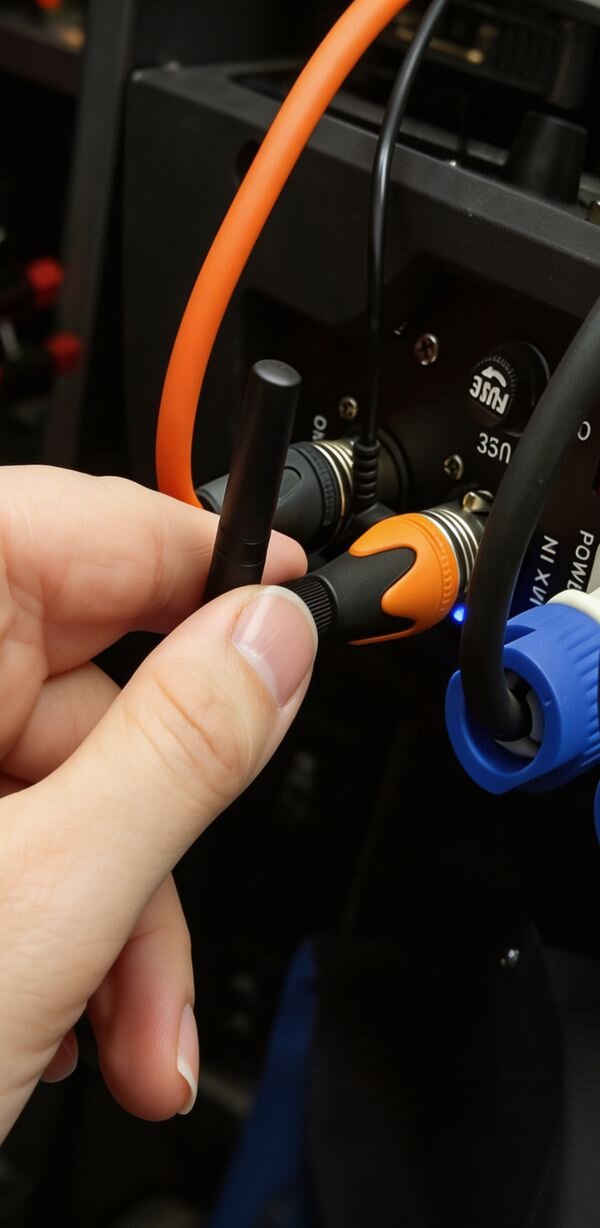
AIR2DMX® hardware sets a new standard for compactness — its housing is barely larger than a standard Neutrik XLR connector. This minimal footprint lets you plug the interface directly into a fixture’s DMX input, without extra mounts or bulky housings in the way. This is a decisive advantage especially at exclusive galas, in white-walled churches, or in museums, where the technology practically disappears from view. Despite its small size, the device houses state-of-the-art electronics for absolutely reliable signal processing, making it currently the most compact professional receiver on the market.
Fail-Safe Features: Hold Last Value and Static Scenes
Safety is a top priority at AIR2DMX®, which is why the system includes sophisticated fail-safe functions. By default, if the signal is lost, the last Art-Net DMX value received is held (“Hold Last Value”) until new data packets arrive. The interface can also be configured with a static fail-safe scene that activates automatically if the Wi-Fi connection drops permanently (for example, due to a software crash). This scene stays active until a valid signal returns or power is disconnected. These safety mechanisms are essential for avoiding embarrassing blackouts during an event or a trade show build, under any circumstances.
Process Reliability and Time Savings in Trade Show Builds
In the hectic pace of trade shows, lighting installations often have to run reliably for days without constant technical supervision. AIR2DMX®’s “DMX at Startup” feature ensures that booths light up immediately in the desired brand color as soon as the main power comes on each morning. The system also saves significant time when building complex booth structures with truss rigging, since time-consuming overhead cabling is eliminated entirely, lowering labor costs per project. The hardware’s robustness ensures the lighting mood stays stable even in exhibition halls with extremely heavy wireless traffic from visitor Wi-Fi, so exhibits are always presented perfectly.
Sustainability Through Firmware Updates
At a time when technology cycles keep getting shorter, AIR2DMX® takes a sustainable approach by offering continuous firmware updates. Instead of needing to buy new hardware for every new feature or minor bug fix, existing interfaces can simply be updated via software, conserving valuable resources. This environmental approach ensures your interface stays a modern, capable tool for many years, without generating e-waste from hardware replacement. The hardware’s longevity, combined with this update strategy, makes investing in AIR2DMX® a future-proof and environmentally responsible decision.
Efficient Data Distribution via Art-Net Broadcast
In the world of Wireless DMX, the transmission protocol plays a key role in performance, and broadcast mode is one of the simplest forms of data distribution. Here, the software sends DMX data packets to every device on the network simultaneously, which greatly simplifies setup since no specific IP addresses need to be assigned. For small to mid-sized setups, this is the most efficient way to get a wireless link running quickly and without hassle, since every AIR2DMX® interface on the network can process the data immediately. AIR2DMX®’s implementation ensures these packets are processed reliably, which makes for stress-free setup, especially in mobile applications.
Targeted Signal Control via Unicast Communication
For larger installations with many DMX universes, Wireless DMX via unicast offers significantly higher performance and network stability compared to broadcast. In unicast mode, the control software sends Art-Net packets specifically to the IP address of the particular AIR2DMX® interface the data is intended for. This considerably reduces the overall network load on the Wi-Fi router, since uninvolved devices aren’t burdened with unnecessary traffic. Professionals use unicast to achieve maximum freedom from latency when many different lighting circuits need to be controlled independently. AIR2DMX® hardware is fully optimized for this professional addressing mode and integrates easily into complex IP structures.
Signal Integrity Through Line-of-Sight Awareness
To ensure the maximum range and stability of Wireless DMX, it’s essential to observe physical principles like the Fresnel zone and line of sight. For optimal wireless transmission, AIR2DMX® interface antennas should ideally be positioned above the heads of the audience and without major obstacles between them. Since radio waves are attenuated by human bodies or metal structures, raising the position of transmitters and receivers significantly improves signal quality. Our technology is designed to maintain precise signal integrity even over long distances, as long as these basic principles of radio transmission are observed — enabling ranges that go far beyond what traditional cable runs can achieve.

Improved Safety by Eliminating Trip Hazards
Workplace and audience safety is a central concern in any professional event, where floor cable is always a significant risk. By consistently using Wireless DMX, you eliminate one of the most common sources of accidents: the dangerous trip hazard posed by XLR cable on dance floors or in escape routes. AIR2DMX®’s wireless solutions make bulky cable ramps or the tedious job of taping down cable with gaffer tape largely unnecessary, which not only reduces liability risk but also protects sensitive flooring. A cable-free setup also signals a high level of responsibility to clients and guests, since the entire work environment looks tidy and safe.
Quality and Expert Support, Made in Germany
In summary, Wireless DMX from AIR2DMX® is a highly professional solution for demanding users who value quality, safety, and cost-effectiveness. Our products and software solutions offer the decisive advantage of direct, knowledgeable support in your own language, helping you with complex project planning. Instead of dealing with anonymous hotlines, you get support from experts who understand the day-to-day challenges of live events from their own experience. Trust a solution “Made in Germany” that makes your light shows more flexible and gives you the freedom to focus entirely on your creative work, while the technology runs reliably and invisibly in the background.
Frequently Asked Questions About Wireless DMX
What’s the difference between Wireless DMX and radio DMX?
In everyday use, both terms are often used interchangeably. Strictly speaking, “radio DMX” usually refers to classic point-to-point radio systems with a proprietary protocol, while Wi-Fi DMX interfaces like AIR2DMX transmit the open Art-Net protocol over standard Wi-Fi. For the user, what matters most is the same either way: no more DMX cable.
How far does Wi-Fi DMX reach?
This depends heavily on obstacles and other Wi-Fi networks nearby. As a guideline: AIR2DMX-micro covers about 30 m indoors / 70 m outdoors, AIR2DMX-PRO about 40 m indoors / 120 m outdoors, and the PRO-HR variant about 50 m indoors / 200 m outdoors.
Is the delay (latency) of Wi-Fi DMX noticeable on stage?
For the vast majority of applications — color changes, chases, fader moves, moving-head positioning — the extra delay compared to a cable connection isn’t noticeable, as long as the Wi-Fi environment is clean. In heavily congested wireless environments (many overlapping Wi-Fi networks), it can become noticeable. If you want to be completely safe with time-critical effects, run the interface on its own hotspot rather than on someone else’s network.
Wireless DMX: Cable-Free Freedom for Your Professional Lighting Control
Say goodbye to tangled cable runs and tripping hazards from XLR cable. With air2dmx’s Wireless DMX solutions, you get state-of-the-art wireless technology that combines flexibility with absolute reliability.
Whether for mobile DJ gigs, gala evenings, or complex stage productions — the requirement for modern lighting control is clear: it has to be ready to go fast, stable, and invisible. Wireless DMX (also called radio DMX) has revolutionized the way lighting technicians work.
Instead of running hundreds of meters of cable through truss rigging or across dance floors, you now transmit your control signals loss-free through the air.
Use Cases for Cable-Free DMX Systems
Mobile DJs & Weddings: Set up your rig in record time. No more ugly cable channels along the façade or across the room. For a detailed look at how cable-free DMX control works on set, in architectural lighting, and at trade shows, see the guide above.
Future-Proof Technology for Your Lighting Setup
A modern DMX interface today has to do more than just send signals — it has to become part of your digital workflow. At air2dmx, we focus on durable hardware “Made in Germany” that holds up to the rigors of life on tour. Trust our expertise and take your light show to the next level.
Ready to make the switch? Discover our Wireless DMX solutions now and experience the next dimension of lighting control.